

Ground Extracted Fields
The new Ground API (POST /v2/ground) maps each field extracted by Extract back to the blocks it was quoted from in the Parse response. For every extracted value, it returns the matching blocks with their ids, page numbers, and bounding boxes, so you can highlight values on the page, build review interfaces, attach citations, or crop the regions values came from.Grounding is a stateless join over two objects you already have: the Extract response’s extraction_metadata and the Parse response’s structure. It runs synchronously, completes quickly, and consumes no credits.Get Started
This release adds webhook notifications, changes the model values you send to Parse and what the Parse response reports, and moves Extract to a new default snapshot:
- Get Notified When Runs Finish
- Model Values for DPT-3 Verity
- Confidence Appears Only on Word Entries
- Response Values Are Shorter
- New Extraction Model Snapshot
- Oversized Images Return an Error Right Away
Get Notified When Runs Finish
You can now register webhook endpoints that receive a signed event when a Parse or Extract run succeeds or fails, instead of polling for job status. Events carry job identifiers and status, never document content, and fire for synchronous requests and async jobs alike. Manage endpoints in Playground > Settings > Webhooks.See Webhooks.Model Values for DPT-3 Verity
Parse and Parse Jobs now acceptdpt-3-verity, dpt-3-verity-latest, and dpt-3-verity-20260804-preview, matching the model’s name. These values previously carried the model’s earlier name, DPT-3 Fast.Requests that pin dpt-3-fast, dpt-3-fast-latest, or dpt-3-fast-20260804-preview still work, so no code change is required. The response reports the new name instead of the one you sent. For example, a request pinning dpt-3-fast-20260804-preview comes back with metadata.model_version set to dpt-3-verity-20260804-preview.Nothing about the model changed. The rename did not create a new snapshot.Confidence Appears Only on Word Entries
On DPT-3 Verity parses, theconfidence score now appears only on the word entries of atomic_grounding. The grounding of a block, table_cell, table, or page no longer carries one.To get a block’s lowest score, take the minimum confidence across its word entries. Setting options.atomic_grounding to false now removes every score from the response, because the scores live on the word entries. See Word Confidence Scores.Response Values Are Shorter
Bounding box coordinates now carry at most 5 decimal places, andconfidence at most 2. See Grounding.New Extraction Model Snapshot
Extract and Extract Jobs now accept theextract-20260819 snapshot, and it is the default. Requests that omit model, or that send extract-latest or extract, run on it.Extraction results can change with a new snapshot. To keep the previous behavior, pin extract-20260710, which stays available. The response reports which snapshot ran in metadata.model_version.See Model Version.Oversized Images Return an Error Right Away
Parse now answers immediately with a 422 error when an image is larger than 178,956,970 pixels (about 179 megapixels). Previously the request kept processing until it timed out, so you waited for the full timeout to learn the image was too big. No credits are consumed either way.See Troubleshoot Parsing.Restrict API Access by IP Address
Organizations on the Enterprise plan can now restrict their access to the ADE APIs to a set of approved IP addresses. When an allowlist is active, API requests from any other address are rejected. The allowlist applies to every request to the v1 and v2 APIs, no matter which API key is used. It does not restrict the Playground.To enable an allowlist, email support@landing.ai with the IPv4 or IPv6 addresses and CIDR ranges to approve. See IP Address Allowlist.Parse with DPT-3 Verity (Preview)
Parse and Parse Jobs now offer a second model family: DPT-3 Verity, a preview model optimized for digitally created text documents. Setmodel=dpt-3-verity on a request, or select DPT-3 Verity in the Playground model drop-down. The default model remains DPT-3 Pro.Compared with DPT-3 Pro, DPT-3 Verity:- Returns results faster and consumes fewer credits. For credit rates, go to Credit Consumption.
- Grounds every word in text, tables, and marginalia. The
atomic_groundingarray carries one entry per word, including the words inside table cells. See Atomic Grounding. - Scores every word it transcribes in text, tables, and marginalia. Each word entry carries a
confidencevalue, so you can route uncertain transcriptions to review. The Playground highlights low-confidence words. See Word Confidence Scores. - Optimized for digitally created documents and Latin scripts. For scanned or handwritten documents, non-Latin scripts, math formulas, or detailed figure descriptions, choose DPT-3 Pro. For the full comparison and guidance on choosing a model, see Parsing Models.
This model was released as DPT-3 Fast and renamed to DPT-3 Verity on August 26, 2026. The
model parameter values changed with it, and requests that pin the earlier dpt-3-fast values still work.Library Support
Word confidence scores require the Python Library v1.17.0 or later, or the TypeScript Library v2.12.0 or later.Out-of-Range Page Selections Are Rejected
Parse now rejects anoptions.pages selection that includes a page beyond the document’s last page with a 422 error that names the invalid pages. Previously the same request could return a 500, a partial 206 result, or an empty result. A single out-of-range value rejects the whole request, and no credits are consumed.Parse Jobs runs the same check after the job starts, because the page count is not known at submission. An out-of-range selection fails the job, and the poll response reports the invalid pages in the error field.See Troubleshoot Parsing.Parse Office Documents
Parse and Parse Jobs now accept Word documents (DOCX), PowerPoint presentations (PPTX), OpenDocument text (ODT), and rich text files (RTF), in addition to PDFs and images. Office files are converted to PDF before parsing.You can also upload DOCX, PPTX, and ODT files in the Playground.See Supported File Types.Expired Delivery URLs Are Rejected at Submission
Parse Jobs and Extract Jobs now validate theoutput_save_url when you create the job. A presigned URL that is already expired, or that expires before the job can complete, is rejected with a 422 error at submission instead of failing at delivery after the document is processed.No credits are consumed for the rejected request.See URL Requirements.Set Credit Usage Alerts
You can now set alerts that email your team when your organization’s credit consumption crosses a threshold. Organizations with a subscription start with three default alerts at 80%, 90%, and 100% of quota. See Credit Usage Alerts.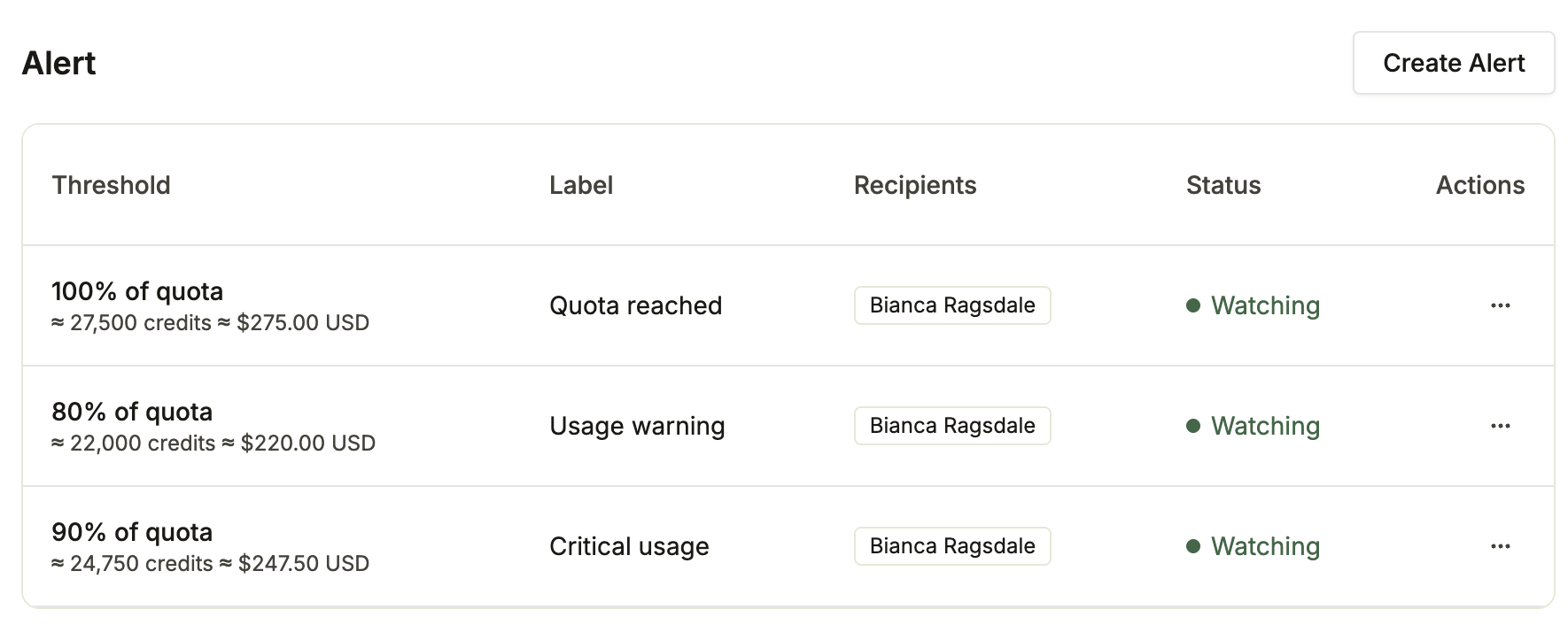
Billing Metadata for Jobs That Save Output to a URL
Parse Jobs and Extract Jobs created withoutput_save_url now report the job’s metadata (including billing) in the completed poll response, and the file delivered to your URL contains the complete response, also including metadata.This also applies to jobs that completed before this change: poll the job again, and the response now includes its metadata.Smoother Job Progress Reporting
Theprogress field on Parse Jobs and Extract Jobs polls now updates on every poll as an estimate of how close the job is to completion, instead of staying at 0 for most of a run.Playground Updates
- Search the parse results with the toolbar’s find-in-page search, fold JSON objects, and toggle word wrap. See Review the Results.
- The parse toolbar is redesigned, and the Config menu’s grounding control is now named Atomic grounding (previously “Fine-grained output”). See Customize the Parse Output with Config.
- Hovering a block in the Parse tab reveals its per-line and per-cell boxes on the document, and hovering an extracted field in the Extract tab highlights and labels where its value appears in the document.
The ADE v2 APIs Are Generally Available
The Agentic Document Extraction v2 APIs, powered by DPT-3, are now generally available: Parse, Parse Jobs, Extract, and Extract Jobs.We have made many improvements since the May Preview, including faster processing and a cleaner, more consistent response format.Quickstart
Parse your first document with the v2 APIs.
Migration Guide
Move from the v1 (DPT-2) APIs.
New Guide: Choose a Processing Mode and Service Tier
The new Sync vs Async Processing guide compares the three ways to process documents, so you can choose the right call for each workload:- Synchronous requests
- Jobs on the
prioritytier - Jobs on the
standardtier (the default)
New Response Format for the Parse and Extract v2 APIs
We updated the response format of the Parse v2 and Extract v2 APIs based on developer feedback. The endpoints, authentication, and Markdown output format are unchanged. The changes are breaking if your code reads thestructure or grounding output from Parse, the extraction_metadata output from Extract, sends the options.pages selector, or polls Parse Jobs.For the current response shapes, see Parse API Response and Extract API Response. For the full list of changes and how to update your code, see the July 17 Migration Notes.Simplified Pricing
We have simplified pricing. For the Explore and Team plans, $1 buys 100 credits. This is applicable to both the EU and US regions. See Plans & Billing.Credit consumption rates are unchanged. To see how many credits each API call consumes, go to Credit Consumption for ADE v2.Fixed: Bounding Boxes for EXIF
Images with EXIF orientation metadata (such as phone photos) are now parsed upright, so bounding boxes align with the image as a viewer sees it. See Working with Boxes.This release updated the Parse v2 API and launched three new Agentic Document Extraction v2 APIs, all powered by DPT-3:
- Parse Jobs v2: Parse documents asynchronously. Submit a document, receive a
job_id, and poll for the result. Jobs accept up to 6,000 pages and 1 GiB per PDF, and can save output directly to a URL you control. - Extract v2: Pull specific fields from Markdown with a JSON schema, with span-level grounding that maps each value back to its source.
- Extract Jobs v2: Run long-running extractions asynchronously, for long documents or large schemas.
standard (the default, half the credits) or priority (faster turnaround at the full rate). For current tier behavior, see Sync vs Async Processing.Also in this release:- New Playground URL. The Agentic Document Extraction Playground moved to ade.landing.ai in the US and ade.eu-west-1.landing.ai in the EU. Links to the previous
va.landing.aiURL redirect automatically. - Redesigned Usage page. The Usage page shows daily and monthly consumption charts and detailed per-job logs. See Monitor Credit Usage.
HTML Tables by Default
Tables now return as HTML instead of pipe-syntax Markdown. HTML preserves merged cells and nested layouts that pipe syntax cannot represent.Parse Options in the Playground
The Parse tab’s Config menu now exposes DPT-3 parse options directly in the browser: choose which element types to caption, set the table output format, toggle fine-grained grounding, and select specific pages.These controls map to the API’soptions field.See Parse in the Playground.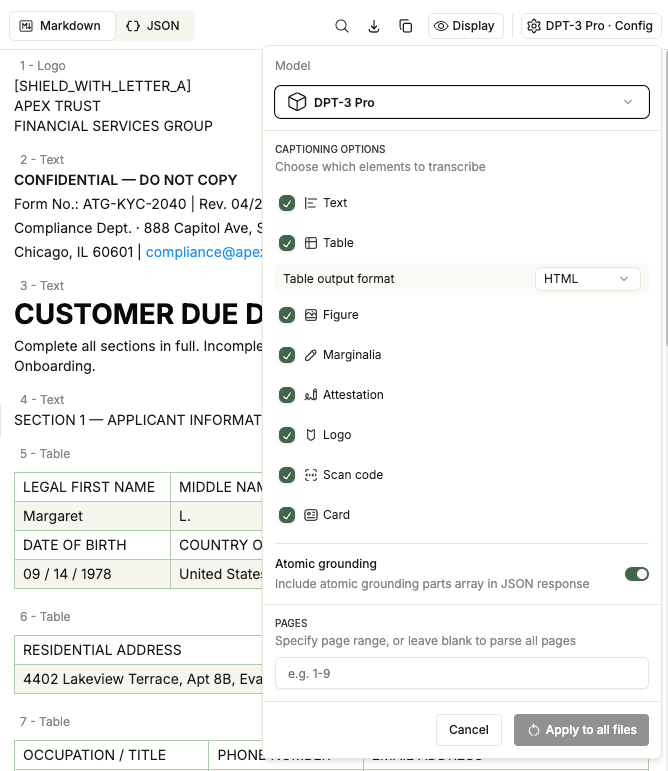
Preview of DPT-3 and the New Parse API
DPT-3, our newest parsing model, and the redesigned Parse API are now available in Preview. DPT-3 is a complete rethink of document parsing for the era of AI agents and agentic workflows: a new model architecture, a new response shape, and complexity-aware pricing.Parse in the Playground
Upload a document directly in the browser. No code required.
Call the API
See parameters, response fields, and code samples.
Highlights
- Designed for agent systems. Semantic block ids, a predictable hierarchy, and Markdown span pointers so AI agents can map results back to source.
- Hierarchical layout model. The structured output is a nested hierarchy: pages, blocks on each page, and cells within tables.
- Visual grounding. A bounding box on every block, plus finer-grained grounding within blocks.
- Cleaner, more standardized Markdown. Consistent, structured Markdown output designed for RAG and downstream processing.
- New endpoint and response shape. Calls go to the new API, which returns the document as Markdown plus a hierarchical
structuretree. See the Migration Guide.